
Comparing a dental implant vs. bridge for one missing tooth? Learn how they differ in tooth preparation, treatment time, maintenance, and long-term considerations.
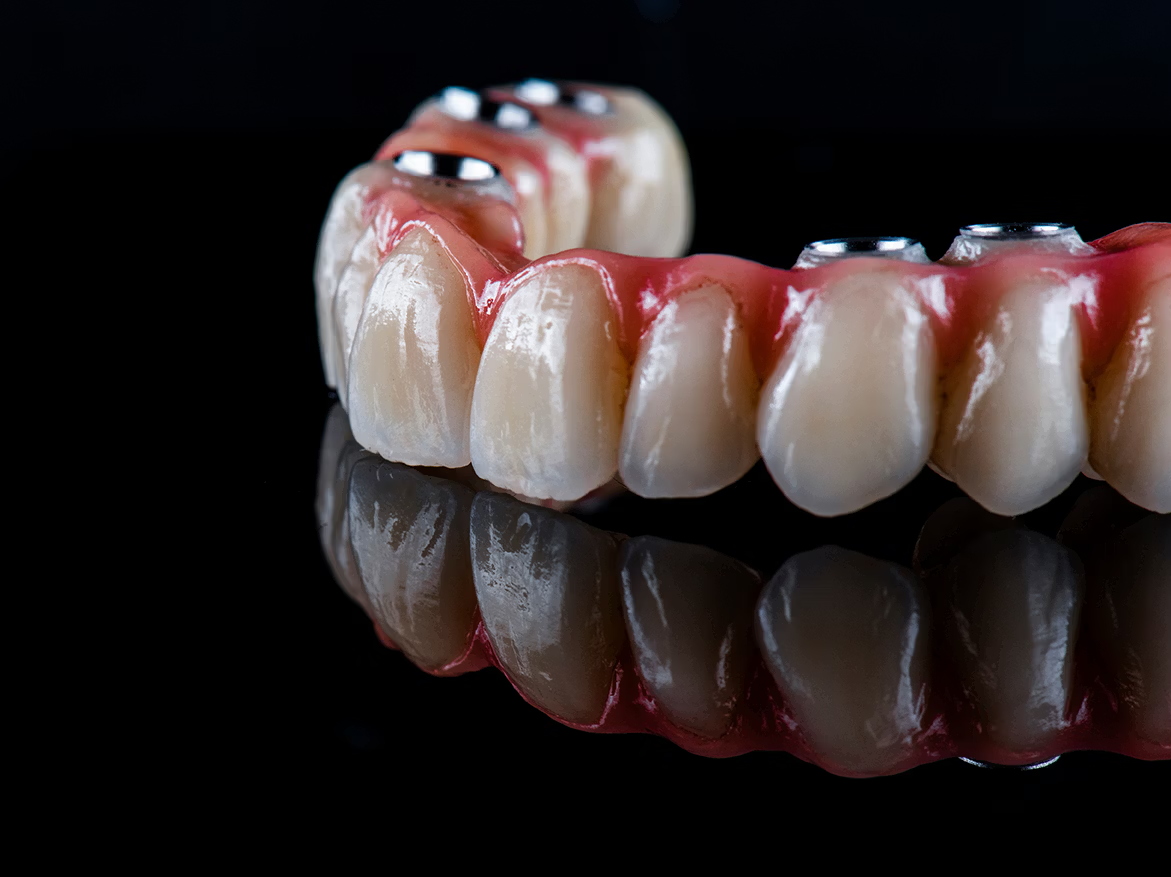
Losing one tooth can leave you with a surprisingly big decision.
You may be looking at the space in your smile and wondering whether you really need to replace it, and if you do, whether a dental implant or bridge makes more sense.
Both options can replace a single missing tooth. The important difference is how they do it.
A traditional dental bridge uses the teeth next to the gap for support. A dental implant replaces the missing tooth root with an implant post and supports a replacement tooth, usually a crown. The right choice depends on factors such as the health of your neighboring teeth, your jawbone, treatment timeline, budget, and long-term goals.
At LIVCO Dentistry in Howell, a single-tooth implant is one of the options available for replacing a missing tooth without disturbing the neighboring teeth.
The simplest way to think about the two options is this:
A bridge replaces the missing tooth by using nearby teeth for support. An implant replaces the missing tooth root and supports the replacement tooth independently.
A traditional dental bridge typically has a false tooth, called a pontic, connected to crowns that fit over the natural teeth on either side of the gap. Those neighboring teeth serve as the support for the bridge.
A dental implant works differently. The implant post is placed into the jawbone and acts as an artificial tooth root. Once the implant has healed, a replacement tooth can be attached to it. LIVCO Dentistry describes its single-tooth implants as a way to fill a gap while leaving the neighboring teeth undisturbed.
For some people, an implant is appealing because it treats the missing tooth as an individual tooth rather than relying on the teeth beside it.
One major advantage is that a traditional tooth-supported bridge requires preparation of the neighboring teeth. An implant does not require the adjacent teeth to be altered to support the replacement tooth.
Implants also replace the root of the missing tooth. That matters because the jawbone normally receives stimulation from tooth roots, and bone can be lost after a tooth is removed. Dental implants can help preserve the bone around the missing tooth.
An implant may be worth discussing if:
LIVCO Dentistry's dental implant service includes single-tooth implants specifically for patients missing one tooth.
A bridge can be a practical option when the neighboring teeth are suitable to support it.
One advantage is the treatment timeline. Implant treatment involves surgical placement and a healing period before the final restoration is attached. Cleveland Clinic notes that implant healing can take several months, although the exact timeline varies from person to person.
A traditional bridge does not require an implant to heal into the jawbone. Instead, it relies on prepared neighboring teeth for support. That can make a bridge an appealing option when treatment time, anatomy, or other circumstances make an implant less suitable.
A bridge may be worth discussing if:
The condition of the teeth surrounding the missing tooth is an important part of the decision. A bridge depends on those teeth for support, so their strength and health matter.
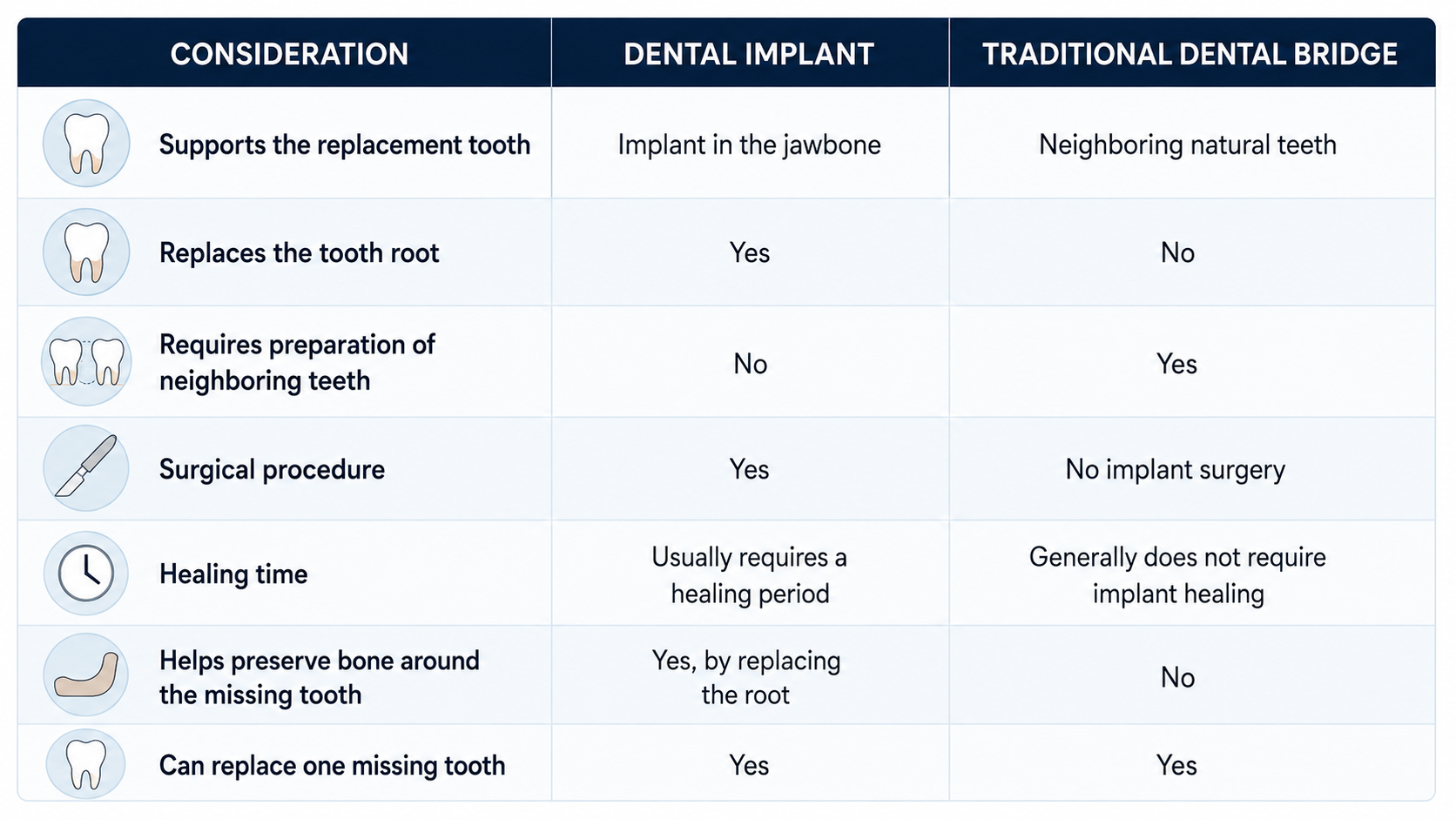
Neither option is automatically right for everyone. Your dentist needs to look at the missing-tooth area, neighboring teeth, gums, bone, and your overall oral health before recommending a treatment.
Cost is often part of the decision, but it is difficult to give a meaningful one-size-fits-all comparison.
The total cost can depend on the condition of your mouth, the type of restoration needed, whether additional procedures are required, dental insurance benefits, and your treatment plan.
It is also worth looking beyond the initial price. An option that costs less upfront may have different maintenance or replacement considerations over time. A dentist can help you compare the expected treatment, care requirements, and long-term considerations rather than looking at the initial number alone.
If cost is one of your concerns, ask for a clear explanation of what is included in each treatment option and whether your dental benefits apply.
There is no universal winner in the implant vs. bridge decision.
For a person with healthy neighboring teeth who wants an independent replacement for the missing tooth, a dental implant may be an attractive option. For someone whose neighboring teeth are already heavily restored, who wants to avoid implant surgery, or who has other treatment considerations, a bridge may make more sense.
That is why an examination matters.
LIVCO Dentistry's restorative dentistry services include treatments for damaged or missing teeth, including dental implants. If you are weighing your options, the goal is not simply to choose the treatment that sounds better on paper. It is to determine which option fits the condition of your teeth, your oral health, your timeline, and your goals.
If you are deciding between an implant and a bridge, consider asking your dentist:
Getting answers to these questions can make the decision much easier.
Not necessarily for every patient. An implant replaces the missing tooth root and does not require the neighboring teeth to support the replacement. A bridge uses adjacent teeth for support and may be a practical alternative depending on their condition and your treatment goals.
A traditional tooth-supported bridge requires the neighboring teeth to be prepared so they can support the bridge. That is different from an implant, which is placed independently of the adjacent teeth.
Implant treatment often takes several months because the implant needs time to heal and integrate with the jawbone before the final restoration is placed. The exact timeline depends on the individual treatment plan.
Yes. A traditional dental bridge can replace a single missing tooth by using the neighboring teeth as supports.
It is worth discussing the decision with a dentist rather than assuming the space will not cause problems. Missing teeth can affect chewing and speaking, and neighboring teeth can shift into the space. Bone loss can also occur around a missing tooth.
If you have one missing tooth, you do not have to decide between an implant and a bridge based on a quick online comparison.
A dental evaluation can help determine whether the teeth around the gap are healthy, whether the area has enough bone for an implant, and which treatment better fits your needs.
LIVCO Dentistry in Howell offers dental implants, including single-tooth implants, as well as restorative dentistry for repairing and replacing damaged or missing teeth.
If you are considering an implant vs. bridge for a single missing tooth, schedule an evaluation with LIVCO Dentistry to discuss your options.
Experience top-quality dental care at LIVCO Dentistry. Dr. Kala Mapes and her dedicated team are here to ensure your family's oral health in a welcoming and comfortable environment.
